
RGUHS Nat. J. Pub. Heal. Sci Vol No: 5 Issue No: 3 eISSN:
Dear Authors,
We invite you to watch this comprehensive video guide on the process of submitting your article online. This video will provide you with step-by-step instructions to ensure a smooth and successful submission.
Thank you for your attention and cooperation.
1Dr. Riyas Basheer K B, Vice Principal and Associate Professor, Tejasvini Physiotherapy College, Kudupu, Mangalore, Karnataka, India.
2Tejasvini Physiotherapy College, Kudupu, Mangalore, Karnataka, India
3Tejasvini Physiotherapy College, Kudupu, Mangalore, Karnataka, India
4Tejasvini Physiotherapy College, Kudupu, Mangalore, Karnataka, India
5Tejasvini Physiotherapy College, Kudupu, Mangalore, Karnataka, India
6Department of Community Medicine, AJ Institute of Medical Sciences, Mangalore, Karnataka, India
*Corresponding Author:
Dr. Riyas Basheer K B, Vice Principal and Associate Professor, Tejasvini Physiotherapy College, Kudupu, Mangalore, Karnataka, India., Email: riyas2423@gmail.com
Abstract
Background and Objectives: Agility is a critical component of athletic performance and is influenced by physical traits such as body composition, segmental lengths, and motor coordination. This study investigates the relationship between anthropometric measurements and agility among college students (both genders) aged 18 to 25 years, targeting a non-athletic population.
Methods: The study included 85 college students (45 males, 40 females). Anthropometric data, including body mass index (BMI), body fat percentage, waist-hip ratio (WHR), and segmental lengths (foot, leg, thigh), were measured. Agility was assessed using the Agility T-Test and the Illinois Agility Test. Data were analyzed using Pearson’s correlation coefficient, with P < 0.05 considered significant.
Results: Males exhibited superior agility, completing the agility assessments faster than females. BMI and body fat percentage were negatively correlated with agility. Conversely, segmental lengths and lower WHR demonstrated significant positive correlations with agility performance. Total limb length showed the strongest correlation with improved agility outcomes.
Conclusion: Agility is influenced by anthropometric traits: higher BMI and body fat are associated with poorer performance, whereas longer limb length and lower WHR enhance agility. These findings offer valuable insights for agility training and fitness program development in non-athletic populations.
Keywords
Downloads
-
1FullTextPDF
Article
Introduction
Athletic performance today hinges on systematic evaluation of health, physical attributes, movement, and skill fitness. Key factors such as anthropometric traits, motor skills, and physical capacity help identify individuals suited to specific sports. Parents and the global community increasingly expect athletes to excel, driving the need for talent identification. Success depends on aligning physical, behavioural, and motor capabilities with the demands of competitive sports.1
Agility plays a crucial role in sports and activities that demand quick changes in direction, as it hinges on a combination of speed, balance, coordination, and reaction time. By integrating movement with rapid responses to cues, agility not only boosts athletic performance but also helps prevent injuries. Achieving agility requires mastering both speed and the ability to shift direction efficiently. Key factors influencing this ability include strength, spatial awareness, timing, coordination, and balance. Training methods such as plyometric exercises, agility drills, and balance-focused workouts are effective in enhancing agility. In essence, agility is a cornerstone of success in sports and physical activities that require swift and precise movements.2
Body type significantly influences agility by affecting speed and strength. Endomorphs are larger and have higher fat than muscle tissue, while mesomorphs are muscular with minimal fat. Ectomorphs are lean and thin with little muscle or fat. These anthropometric traits impact muscle composition and physical capabilities, highlighting the link between body type and agility.3
According to Spiteri, Hart, and Nimphius, male athletes tend to outperform female athletes in agility tasks due to factors such as greater lower-body strength, greater vertical braking force, greater impulse application, greater knee and spine flexion, greater hip abduction, faster decision-making speed, and greater post-change-of-direction (COD) stride velocity. Agility relies on the ability to swiftly and efficiently change running direction by coordinating upper-body movements while maintaining balance.3
To measure agility, tests like the T-Test and the Illinois Agility Test are commonly used. The T-Test evaluates an athlete’s ability to run forward, laterally, and backward. For accurate and reliable results, a consistent testing surface is essential. The Illinois Agility Test, on the other hand, assesses an athlete’s ability to execute various directional changes and movements efficiently. It is a straightforward, cost-effective test requiring minimal equipment and provides valuable insights into an athlete’s turning ability at different angles and directions.4
Body mass index (BMI), body fat percentage, and waist hip ratio (WHR) are key indicators of body composition and physical fitness. These metrics collectively provide a comprehensive assessment of an individual’s fat mass and are considered essential anthropometric characteristics.5 BMI is calculated as weight in kilograms divided by height in meters squared, serving as a widely recognized measure of body type. WHR, on the other hand, is determined by dividing the waist measurement (in inches) by the hip measurement (in inches). Additionally, segmental lengths, such as foot length, leg length, and total limb length, are measured with inch tapes, providing further insights into physical proportions.6, 7
Studies have explored the relationship between anthropometric measurements and agility, focusing on variables such as BMI, body fat percentage, height, weight, and WHR.6,7 However, these investigations primarily center on athletes, leaving a gap in research concerning non-athletic individuals. This study addresses this gap by examining the general population and offering insights into how physical traits influence agility beyond professional sports.
This study aims to investigate the relationship between anthropometric measurements and agility among college students aged 18 to 25 years. The objectives include evaluating the associations among BMI, body fat percentage, and agility; examining the link between segmental lengths and agility; and analyzing the relationship between WHR and agility in this age group, by gender. By addressing these factors, the study seeks to provide valuable insights into how specific physical and body composition characteristics influence agility.
Materials and Methods
Participants: This study included 85 college students (45 males and 40 females) from the Tejasvini Hospital Group of Institutions, Mangalore. The participants were aged between 18 and 25 years. Predictor variables included age (years), weight (kilograms), height (centimeters), gender, and BMI. Each participant received a brief explanation of the study and provided informed consent prior to data collection.
Selection Criteria: Participants included apparently healthy individuals aged 18 to 25 years, free of any injury. Individuals with a history of extremity fractures, post-traumatic injuries, ligament injuries, deformities, meniscal tears, or ankle conditions, as well as those unwilling to participate, were excluded from the study.
Anthropometric Parameters: This study evaluated several key outcome measures: BMI, WHR, segmental lengths (measurements of foot, leg, and thigh lengths), skinfold measurements by skinfold calipers (Flovein, ASIN: B09ZDP4K4W, Made in India) to measure fat percentage (Jackson and Pallock) at three specific body sites (chest/triceps, abdominal/suprailaic, and thigh).8-11 Jackson-Pollock 3-site formula estimates body fat by first calculating body density using specific equations for men and women, which require a sum of three skinfold measurements and age. For men, the formula is: Body Density = 1.10938 − (0.0008267×Sum) + (0.0000016×Sum2) − (0.0002574×Age), where, Sum is the sum of chest, abdomen, and thigh skinfolds in mm. For women, it’s: Body Density = 1.0994921 − (0.0009929×Sum) + (0.0000023×Sum2) − (0.0001392×Age), where Sum is the sum of triceps, suprailiac, and thigh skinfolds in mm. Once body density is found, the Siri equation is used to convert it to body fat percentage: Body Fat % = ((4.95÷Body Density) − 4.50) ×100.12,13
Anthropometric measurements were obtained from all participants. Skinfold measurements were taken at three sites using a skinfold caliper. WHR was calculated, and segmental lengths, including thigh, leg, and foot lengths, were measured using an inch tape.
Agility Performance: Agility assessments were conducted barefoot using the Agility T-Test and the Illinois Agility Test to ensure accuracy and consistency.14,15
Each measure was carefully chosen to assess different aspects of physical and body composition characteristics that could influence agility. These anthropometric and physiological parameters were key in establishing the relationship between physical traits and agility.
Statistical Analysis: Data analysis was performed using SPSS 21.0. The Kolmogorov-Smirnov test was employed to determine data normality, given that the sample size exceeded 80 participants, and results indicated a normal distribution. Quantitative descriptive analyses were reported as means and standard deviations, while categorical data were presented as percentages. Relationships between variables were evaluated using Pearson’s correlation coefficient, with a 95% confidence interval (P < 0.05).
Results
The study sample consisted of 45 males and 40 females, with average ages of 20.57 ± 1.51 years and 20.55 ± 1.58 years, respectively. Males exhibited higher mean values for height, weight, abdominal skinfold, and thigh skinfold than females. Females showed a lower waist-hip ratio than males (Table 1).
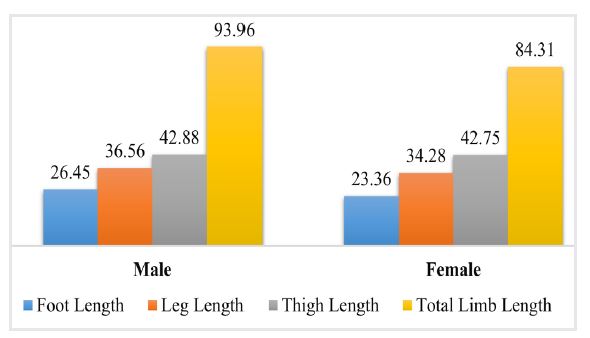
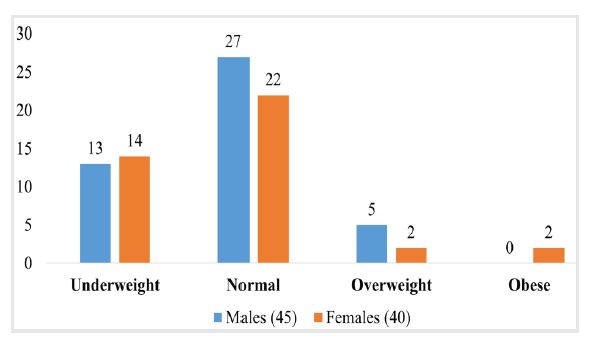
Males demonstrated consistently larger limb measurements, including foot length, leg length, thigh length, and total limb length, compared to females (Figure 1). BMI categories indicate that most individuals fall within the “normal” range, with minimal cases of obesity or underweight status among both males and females (Figure 2).
Agility test results showed better performance among males, who recorded faster times on both the T-Test (12.44 s vs. 15.74 s) and the Illinois Agility Test (18.95 s vs. 22.77 s). Overall, males demonstrated lower average completion times, indicating greater agility than females.
Both males and females exhibited significant negative correlations between agility test times and BMI/body fat percentage. Higher BMI and body fat percentage were associated with poorer agility performance (Table 2). A strong positive correlation was observed between limb segmental lengths and agility performance. Total limb length showed the highest correlation with agility test results for both males and females (Table 3). The WHR was negatively correlated with agility performance in both males and females. Lower WHRs were linked to better agility test results (Table 4).
Discussion
The present study aimed to examine the relationship between anthropometric measurements and agility test performance among young adults. BMI showed a strong positive correlation with body fat percentage, indicating that participants with higher BMI also had higher body fat levels. Moreover, BMI displayed a strong negative correlation with both agility tests, signifying that individuals with higher BMI performed less effectively in agility tasks. These findings align with those of Nunes et al., who reported significant negative associations between BMI and agility in children and adolescents, with overweight or obese groups exhibiting notably reduced agility compared to those with normal BMI.16 Similarly, Savita et al., identified a relationship between BMI, skinfold thickness, and agility in wrestlers, concluding that extended training durations improved agility and flexibility, though correlations between agility and BMI or skinfold thickness were less pronounced.17
A positive relationship was observed between segmental limb lengths (foot, leg, thigh, and total limb) and agility test performance, with longer limb lengths being associated with better agility outcomes. Among these, total limb length exhibited the strongest correlation with agility (r = 0.806). These findings are partially supported by Waseem Raja Mir, who analyzed the impact of anthropometric characteristics on agility among basketball players. The study emphasized that while specific limb measurements were positively associated with agility, overall body weight and height did not have a direct effect on agility.18
A significant negative correlation was identified between WHR and agility test performance. Participants with lower WHR demonstrated better agility. These findings are consistent with the work of Neeraj et al., which assessed the association of WHR, BMI, and body fat percentage with agility among collegiate athletes.19 While WHR itself was negatively correlated with agility, body fat percentage, and BMI, it displayed stronger positive correlations with reduced agility performance.
The results of the study underscore the importance of body composition in determining agility performance. Lower BMI, reduced body fat percentage, longer limb segments, and lower WHR were associated with enhanced agility. These insights can guide athletes, coaches, and fitness professionals in designing targeted agility training programs, particularly for young adults.20 Additionally, these findings are relevant in rehabilitation settings, where customized exercise protocols can help individuals regain agility and physical function after injuries or surgeries. Compared with athlete benchmarks, the study participant’s agility performance was relatively lower, highlighting potential areas for improvement in training and fitness strategies.
Limitations and suggestions: The study’s limitations include a relatively small sample size, which limits the generalizability of the findings and necessitates larger samples in future research to assess the efficacy of the observed correlations accurately. Additionally, all agility tests were conducted barefoot, which might have influenced the results; the use of specialized athletic footwear could potentially yield different outcomes. Furthermore, the study lacked consistent timing protocols during sample collection, which could introduce variability and compromise data reliability. These factors highlight the areas for improvement in methodology for future investigations.
Conclusion
The present study finds that higher BMI is associated with reduced agility. In contrast, longer limb segments and lower waist-to-hip ratios are associated with better agility performance among young adults. These insights provide valuable implications for optimizing agility training and performance.
Ethical Approval: This study was approved by the Institutional Review Board of Tejasvini Physiotherapy College, Mangalore (TPC/PT/2019B/05/2023) dated 15/05/2023.
Conflict of Interest
Nil
Supporting File
References
1. A Parseh, M H Solhjoo. Relationship between anthropometric indexes and motor fitness factors of guidance-school male students. Indian Journal of Fundamental and Applied Life Sciences 2015;5(2):382-387.
2. Sheppard J M, Young W B. Agility literature review: Classification, training and testing. Journal of Sports Science 2006; 24(9):919-32.
3. Lanham-New S A, MacDonald I A, Roche H M. Nutrition and metabolism. John Wiley & Sons Ltd. 2011.
4. Allum J H, Carpenter M G, Honegger F, Adkin A L, Bloem B R. Age‐dependent variations in the directional sensitivity of balance corrections and compensatory arm movements in man. The Journal of Physiology 2002;542(2):643-663.
5. Dudeja V, A Misra, R M Pandey, G Devina. BMI does not accurately predict overweight in Asian Indians in northern India. Br J Nutr 2001;86:105- 112.
6. Popowczak M, Horicka P, Simonek J, Domaradzki J. The functional form of the relationship between body height, body mass index and change of direction speed, agility in elite female basketball and handball players. Int J Environ Res Public Health 2022;19(22):15038.
7. Garcia-Gil, Maria Torres Unda, Jon Esain, Izaro Dunabeitia, Iratxe Gil, Susana M Gil, Javier Irazusta, Jon Anthropometric Parameters, Age, and Agility as Performance Predictors in Elite Female Basketball Players. Journal of Strength and Conditioning Research 2018;32(6):1723-1730.
8. Ruiz-Ariza A, de la Torre Cruz M J, Serrano S L, Oyarzun J C, Lopez E J. Analysis of the effect size of overweight in speed-agility test among adolescents reference values according to sex, age and BMI. Retos: nuevas tendencias en educación fisica, deporte y recreación. 2021;(40):157-63.
9. Imam Hariadi, Nurrul Riyad Fadhli, Dona Sandy Yudasmara. Relationship between body mass index and agility in elementary school students. Advances in Health Science Research (AHSR) and 2nd International Conference on Sports Sciences and Health 2018;7:98-101.
10. Veysel B, Turgut K, Halil T. Investigation of Agility Performance in Some Anthropometric Variables for Young Male Soccer Players. Turkish Journal of Sport and Exercise 2021;23(2):216-222.
11. Lukas O, Zdenek S. The Effect of Age and Anthropometric and Somatic Variables on Agility Performance in Adolescent Ice Hockey Players. Faculty of Physical Culture 2020;2:55-61.
12. Dyal Shiv. Relationship of agility with anthropometric variables of male pace and spin bowlers. International Journal of Physical Education Sports and Health 2018;5(1):132-134.
13. Mohammad A, Tareq A. The relationship between body fat percentage with speed, agility and reaction time of male football players of Bangladesh. International Journal of Sport Culture and Science 2016;4(4):453-60.
14. Mahesh Singh D, Bharat Verma. Relationship of body mass index with agility and speed of university players. International Journal of Physical Education, Sports and Health 2017;4(2):313-315.
15. Subak E, Kaya K, Viga S O, Ocak M H, Agaoglu C, Bekiroglu A. Association between body composition, physical activity level and Illinois agility test performance in young males and females. Physical Education of Students 2022;26(4):180-7.
16. Da Silva Filho J N, de Maio Godoi M M, de Godoi J R. Associations between the body mass index and agility in children and adolescents. Revista Cubana de Medicina Militar 2017;46(4):361-71.
17. Savita S H, Shantala S H, Parwati P P, Shivprasad S G. A cross sectional study to analyse the correlation of body mass index with skin fold thickness and assessment of effect of training and its duration on agility, flexibility and their correlation among wrestlers. Biomedicine 2023;43(01):456-61.
18. Waseem Raja Mir. Relationship of anthropometric characteristics on agility among Kashmir division basketball players. International Journal of Physiology 2018;3(1):434-436.
19. Neeraj K, Nazia S, Sharma P K. Association of selected anthropometric determinants with agility among collegiate athletes. Annals of Yoga and Physical Therapy 2017;2(4):1-3.
20. More A V. Comparative study of flexibility, agility, explosive strength and BMI of basketball and handball players. International Journal of Physiology, Nutrition and Physical Education 2019;4(1):21-3.